One particularly interesting new contact I made at MWC last week was Sinead Quealy of visibility mobile - the mobile SEO company founded by Bena Roberts. As well as telling me about their work on mobile SEO she mentioned they were involved with pushing the "metaTXT" spec through W3C in order to improve discoverability of mobile sites.
Now I have got back and the dust has settled I have had a look at the metaTXT white paper and it seems to be promising stuff. Fundamentally it is an attempt to solve the problem of supporting multiple versions of a site for different classes of device in a way that is transparent to the user - creating a practical step towards the one web ideal I have blogged about before.
What is interesting is it does this by adding a small file (meta.txt) alongside the existing robots.txt at the top of the site providing metainformation about the site. The primary use of this is to provide different paths for the root page for various different device classes - which is all well and good though one webbers may quibble about not driving them via the same markup.
Perhaps more interesting is the ability to provide further meta information about the site within meta.txt - in a standard form independent of any device and/or markup specifics. This can include the usual title and keywords, and intriguingly things like the location the site is related to which opens interesting possibilities for the return of context specific results for the mobile user.
The primary challange they will face with all this is obviously the usual chicken and egg one of convincing sites to publish meta.txt files, and convincing search engines to look for and use them. That said they have already got a couple of mobile search providers deeply involved in the associated working group which is a good sign.
Discovery is one of the key problems that needs to be solved in mobile and this may be one part of the solution to that problem.
Wednesday, February 25, 2009


Monday, February 16, 2009
Truphone's new "intelligent SIM" at #mwc
Every now and again as you wander around the halls of the Fira you trip over something which is clearly a bit of a game changer - something deliciously disruptive. Truphone themselves seem to think so. They are brimming with excitement about it!
The new product - whose availability is still to be confirmed - is based around a combination of two key things:
I will say up front that I am not very clear on the specifics of SIM signalling but as I understand it this effectively this gives them a ~256kbps data channel to the device which is both free and exists whether or not the SIM has been able to formally bind to the host network.
Clearly this opens up many interesting possibilities and I understand that beyond using it to help support their existing voip/roaming products (e.g. intelligence to allow incoming calls to be recived as if local) they are also looking at expanding into situational services - with a continuous location feed being the first element of that.
Of course there is the question of how the more conventional mobile operators will react to this since it will clearly cut into their juicy roaming revenues, and takes a step beyond their control of what happens on their network that they are unlikely to be 100% comfortable with.
This is my first really exciting product (baring our own of course ;-) of the show this year. Look forward to hearing more about it when it is officially released tomorrow.
UPDATE: On reflection I was a little loose in my use of the term data channel above. It is of course a channel that Truphone can use for their own signalling to and from the cpu on the SIM card in order to implement their services - NOT a channel for user IP data.
Truphone have now formally announced their first service built on this kit.
The new product - whose availability is still to be confirmed - is based around a combination of two key things:
- In April 2008 Truphone acquired roaming operator SIM4travel.
- They have now developed a SIM card sporting an ARM core and 2MB of flash storage.
I will say up front that I am not very clear on the specifics of SIM signalling but as I understand it this effectively this gives them a ~256kbps data channel to the device which is both free and exists whether or not the SIM has been able to formally bind to the host network.
Clearly this opens up many interesting possibilities and I understand that beyond using it to help support their existing voip/roaming products (e.g. intelligence to allow incoming calls to be recived as if local) they are also looking at expanding into situational services - with a continuous location feed being the first element of that.
Of course there is the question of how the more conventional mobile operators will react to this since it will clearly cut into their juicy roaming revenues, and takes a step beyond their control of what happens on their network that they are unlikely to be 100% comfortable with.
This is my first really exciting product (baring our own of course ;-) of the show this year. Look forward to hearing more about it when it is officially released tomorrow.
UPDATE: On reflection I was a little loose in my use of the term data channel above. It is of course a channel that Truphone can use for their own signalling to and from the cpu on the SIM card in order to implement their services - NOT a channel for user IP data.
Truphone have now formally announced their first service built on this kit.
Tuesday, February 10, 2009
Barcelona here we come
As I made my final source control commit of the day at midnight last night I reflected briefly on the less glamorous side of the run-up to the four days of frenetic activity that makes up Mobile World Congress. The past week or so has been mayhem and this week is even worse, but now the various demos, graphics and materials are coming together and things are falling into place and it is time to focus on the event itself.
There are many sites out there (and m-trends is a good starting point) listing all the many parties and events striving to gain your attention and your footfall around the conference proper so I won't try to list them here - but there are a couple which deserve a special mention.
Longtime mobile marketeer, blogger, and MoMo London co-organizer Helen Keegan has worked up her usual magic to create not one, but three different events this year. Swedish Beers has moved onto the Wednesday night and into a bigger venue - that being a really good thing after the crush at Belchica last year! Not satisfied with that she is also working with UKTI to organise a fascinating lunch event focussed on the Future of Mobile, and I understand will be announcing a third and final event "for the ladies of mobile" tomorrow.
It is interesting and encouraging to see that despite the economic troubles of the world at large that sponsorship for so many events is still forthcoming. That said it will be interesting to see what the overall visitor numbers end up being. Many of the "usual suspects" to turn up to the whisky reception are taking a year off MWC - the Americans in particular.
Of course within the exhibition itself there are also interesting events - and none more so than the traditional whisky reception run by Scottish Development International on whose stand we are based:
 If you are in the exhibition do come along and enjoy a dram or two. This year there is competition though with Rapid Mobile having branched out onto a stand of their own in hall 7 and running their own whisky tasting starting at 5.30pm on Wednesday evening!
Of course beyond the networking and socialising there will be a *lot* of new devices and services to absorb and evaluate. Will be great to get hands on the new Palm Pre in particular!
One new experience this year is that we are delighted to have been invited to contribute to the mobile advertising sessions on Thursday afternoon in the conference proper - with Chris taking part in the panel on "The New Enablers" and then both of us putting various of our services through their paces in the "Entertainment & Advertising Demonstration & Networking Session". Looking forward to it!
Now time to get back to eclipse and get the next chunk of that demo sorted out!
There are many sites out there (and m-trends is a good starting point) listing all the many parties and events striving to gain your attention and your footfall around the conference proper so I won't try to list them here - but there are a couple which deserve a special mention.
Longtime mobile marketeer, blogger, and MoMo London co-organizer Helen Keegan has worked up her usual magic to create not one, but three different events this year. Swedish Beers has moved onto the Wednesday night and into a bigger venue - that being a really good thing after the crush at Belchica last year! Not satisfied with that she is also working with UKTI to organise a fascinating lunch event focussed on the Future of Mobile, and I understand will be announcing a third and final event "for the ladies of mobile" tomorrow.
It is interesting and encouraging to see that despite the economic troubles of the world at large that sponsorship for so many events is still forthcoming. That said it will be interesting to see what the overall visitor numbers end up being. Many of the "usual suspects" to turn up to the whisky reception are taking a year off MWC - the Americans in particular.
Of course within the exhibition itself there are also interesting events - and none more so than the traditional whisky reception run by Scottish Development International on whose stand we are based:
 If you are in the exhibition do come along and enjoy a dram or two. This year there is competition though with Rapid Mobile having branched out onto a stand of their own in hall 7 and running their own whisky tasting starting at 5.30pm on Wednesday evening!
Of course beyond the networking and socialising there will be a *lot* of new devices and services to absorb and evaluate. Will be great to get hands on the new Palm Pre in particular!
One new experience this year is that we are delighted to have been invited to contribute to the mobile advertising sessions on Thursday afternoon in the conference proper - with Chris taking part in the panel on "The New Enablers" and then both of us putting various of our services through their paces in the "Entertainment & Advertising Demonstration & Networking Session". Looking forward to it!
Now time to get back to eclipse and get the next chunk of that demo sorted out!
Saturday, January 31, 2009
Use your loaf - anonymised sms messaging
"Never give out your mobile number again use your loaf.co.uk The safe anonymous way to send sms txt messages from your UK mobile phone."
That is how loaf introduced themselves to the world on 19th December and at first glance it makes a very appealing proposition for the youth dating and small advertising demographics which appear to be the key markets they had identified.
The core idea is very simple. Instead of being identified by your real mobile phone number when sending or receiving text messages you use your loaf name instead. All messages are sent to and from the loaf 25p MO premium shortcode - 88845.
Recipients can control access to their loaf name by blocking particular senders if they so wish.
To succeed the service will need to generate a relatively large volume of traffic. The rev share on a 25p premium message will barely cover the cost of the resulting bulk MT message. The tiny remaining margin will have to be multiplied up a *lot* of times to cover the company's overheads.
This will be improved slightly by the "mobile-to-email" feature - sold as a bonus feature for the users but in reality a bit of a business model saver since it will reduce their bulk SMS costs and increase the revenue generated from users who take it up by at least a factor fo five!
There are some potential rough edges:
This is a huge and possibly terminal problem for service uptake since if you give out your loaf id to someone who is not on loaf they must choose to go to the website and sign up in order to send you a message - and any mobile service that requires the user to go to their PC has little chance of success.
If they could handle signup interactively on mobile that would improve the experience hugely. Hard to see why the bounce message doesn't simply push the user into a mobile internet signup page.
That is how loaf introduced themselves to the world on 19th December and at first glance it makes a very appealing proposition for the youth dating and small advertising demographics which appear to be the key markets they had identified.
The core idea is very simple. Instead of being identified by your real mobile phone number when sending or receiving text messages you use your loaf name instead. All messages are sent to and from the loaf 25p MO premium shortcode - 88845.
Recipients can control access to their loaf name by blocking particular senders if they so wish.
To succeed the service will need to generate a relatively large volume of traffic. The rev share on a 25p premium message will barely cover the cost of the resulting bulk MT message. The tiny remaining margin will have to be multiplied up a *lot* of times to cover the company's overheads.
This will be improved slightly by the "mobile-to-email" feature - sold as a bonus feature for the users but in reality a bit of a business model saver since it will reduce their bulk SMS costs and increase the revenue generated from users who take it up by at least a factor fo five!
There are some potential rough edges:
- To reply via the service requires the user to manually transcribe the senders loaf name from the end of the incoming SMS to the start of the reply - this is error prone and reduces the usability of the service for the typical user.
- The premium messaging cost is collected on the MO which potentially creates complications for using the service since every user who publishes their loaf name is effectively advertising a premium messaging service which may raise a few eyebrows down and PhonePayPlus!
- In addition if the recipient has blocked that particular sender (or as below if the sender is not a loaf member!) the sender still pays the premium charge but gets nothing for it.
This is a huge and possibly terminal problem for service uptake since if you give out your loaf id to someone who is not on loaf they must choose to go to the website and sign up in order to send you a message - and any mobile service that requires the user to go to their PC has little chance of success.
If they could handle signup interactively on mobile that would improve the experience hugely. Hard to see why the bounce message doesn't simply push the user into a mobile internet signup page.
Monday, January 19, 2009
Progress of the artist formally known as mixipix
Having spent a fair chunk of my career in mobile involved with mixipix it is really great to see Zamsana Media, who are now developing that IP, succeed in rolling out products based on that expertise in animated emotional communicontent and messaging services on mobile.
They had already provided the core content for FunText, a rich messaging service which has been launched on a number of operators including 3 in the UK and Sprint in the US.
Now they have launched their first service in their own right - PixMe - which has been initially lanched on Dialog in Sri Lanka as noted by local bloggers. I have no doubt we will be hearing of further launches in other parts of Asia in due course!
Zamsana itself is an interesting company with a creative and corporate core in the UK, backed up by a technical team in Sri Lanka, perfect for providing services into the Asian market and beyond.
They had already provided the core content for FunText, a rich messaging service which has been launched on a number of operators including 3 in the UK and Sprint in the US.
Now they have launched their first service in their own right - PixMe - which has been initially lanched on Dialog in Sri Lanka as noted by local bloggers. I have no doubt we will be hearing of further launches in other parts of Asia in due course!
Zamsana itself is an interesting company with a creative and corporate core in the UK, backed up by a technical team in Sri Lanka, perfect for providing services into the Asian market and beyond.
Wednesday, December 10, 2008
First steps w/ Android!
Again an unusual post - am aiming to be unashamedly technical this time!
Our shiny new G1 arrived yesterday - now down to me to make something work on it! Lots of other folks have reviewed the device from a user perspective, generally coming to the conclusion that it is a great OS somewhat let down by the HTC hardware. Won't disagree with that view, but my focus here is going to be on app development for the beast.
Guess I am showing my age and deteriorating eyesight but I hate devices whose manuals only come on CD - always prefer paper given the choice. Once the manual painstakingly copied onto my PC desktop turned out to be the usual sort of standard - i.e. doesn't tell you much past the basics.
First challenge is simply to get the pathway worked out such that an app I create in eclipse over onto the G1 and fire it up.
Setting up the development environment under winxp is very smooth:
To connect the shiny new phone to the PC so the debugger can see it you need to:
> adb install HelloAndroid.apk
And there we are:
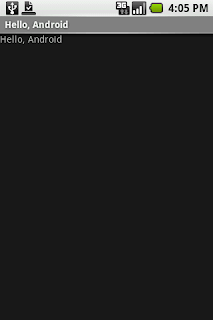 This was captured with the very developer friendly screenshot capture utility which is provided as part of the DDMS perspective for any attached device.
The app will now have appeared in the DDMS perspective allowing heap and thread viewing etc, and you can then simply fire up the debug perspective and set breakpoints etc - all very smooth - works well.
UPDATE: Of course you can skip the adb bit and transfer and run the app in a single step from and Android style eclipse run/debug launch configuration!
PS. Credits - much of this process was picked up from here and here.
PPS. The latest carnival is up over at Mobscure - and my previous post on the Scottish Software Awards gets a mention.
Our shiny new G1 arrived yesterday - now down to me to make something work on it! Lots of other folks have reviewed the device from a user perspective, generally coming to the conclusion that it is a great OS somewhat let down by the HTC hardware. Won't disagree with that view, but my focus here is going to be on app development for the beast.
Guess I am showing my age and deteriorating eyesight but I hate devices whose manuals only come on CD - always prefer paper given the choice. Once the manual painstakingly copied onto my PC desktop turned out to be the usual sort of standard - i.e. doesn't tell you much past the basics.
First challenge is simply to get the pathway worked out such that an app I create in eclipse over onto the G1 and fire it up.
Setting up the development environment under winxp is very smooth:
- Download the current (v1.0 r2) Android SDK and unpack in some sensible folder.
- Add https://dl-ssl.google.com/android/eclipse/ to your list of eclipse plugin download sites and install everything you find there.
- Restart eclipse and in the new Android properties section stick in the path to the SDK directory.
- Extend your system path variable to include the SDK's tools directory.
To connect the shiny new phone to the PC so the debugger can see it you need to:
- On the phone go into settings-->applications-->development and switch on USB debugging.
- Connect the phone and when it screams about the missing driver point it towards the usb_driver subdir in the SDK folder.
- (Re)start eclipse and the phone should appear in the DDMS perspective.
> adb install HelloAndroid.apk
And there we are:
 This was captured with the very developer friendly screenshot capture utility which is provided as part of the DDMS perspective for any attached device.
The app will now have appeared in the DDMS perspective allowing heap and thread viewing etc, and you can then simply fire up the debug perspective and set breakpoints etc - all very smooth - works well.
UPDATE: Of course you can skip the adb bit and transfer and run the app in a single step from and Android style eclipse run/debug launch configuration!
PS. Credits - much of this process was picked up from here and here.
PPS. The latest carnival is up over at Mobscure - and my previous post on the Scottish Software Awards gets a mention.
Monday, December 01, 2008
A fun night at the awards!
Unusually for this blog, which is usually more about things in the wider industry, am unashamedly going to concentrate on our own success today. I hope you will allow me this indulgence!
For those who don't know exactly what Mobile Acuity is all about (and yes we really must update the website sometime soon) the core thing we provide is a mechanism to allow users to interact with a mobile service by taking pictures with their phone, generally as part of brand marketing campaigns. Specifics vary between campaigns but we can then do things like:
While Mobile Acuity's technologies and services have underpinned projects which have won a number of awards so far this year, and we have even been allowed to talk about some of them publicly like Vodafone "Shoot and Score" which was succinctly summarised by techgutter, Friday night was the first awards we have contested in our own right since I have joined the company. The project we based our entry on was also the first I worked on after joining the company.
The awards in question were the Scottish Software Awards, an annual bash celebrating the best of the industry in Scotland, held in the Radisson SAS Hotel in Glasgow. Usefull and interesting group of people to chat to over drinks beforehand, and then through to the awards.
Was great to see so many companies shortlisted in the wireless / mobile category - good sign for the health of the sector in Scotland! Other than ourselves the shortlist consisted of:
Update: A good summary with a bit of a twist in the tail over at Fasterfuture with Richard Marshall as guest contributor.
PS. The latest carnival is up over at All About iPhone - though by Steve Litchfield rather than Matt Radford!
For those who don't know exactly what Mobile Acuity is all about (and yes we really must update the website sometime soon) the core thing we provide is a mechanism to allow users to interact with a mobile service by taking pictures with their phone, generally as part of brand marketing campaigns. Specifics vary between campaigns but we can then do things like:
- recognise what the picture is of - e.g. specific promo materials etc. User friendly linkage between print and mobile media.
- recognise which particular part of the target the user has "pointed" their phone at - image zoning.
- recognise/extract the colours in the image - colour id.
- extract parts of the image and rework into media (e.g. video) to return to the user - virtual bluescreen.
While Mobile Acuity's technologies and services have underpinned projects which have won a number of awards so far this year, and we have even been allowed to talk about some of them publicly like Vodafone "Shoot and Score" which was succinctly summarised by techgutter, Friday night was the first awards we have contested in our own right since I have joined the company. The project we based our entry on was also the first I worked on after joining the company.
The awards in question were the Scottish Software Awards, an annual bash celebrating the best of the industry in Scotland, held in the Radisson SAS Hotel in Glasgow. Usefull and interesting group of people to chat to over drinks beforehand, and then through to the awards.
Was great to see so many companies shortlisted in the wireless / mobile category - good sign for the health of the sector in Scotland! Other than ourselves the shortlist consisted of:
- Mobiqa - mobile barcodes, in particular for airline boarding passes at present.
- NXVision - placeshifting and sideloading TV media onto mobile.
- Rapid Mobile - mobile apps and the Ad360 interstitial mobile ads platform.
- Real Time Engineering - network services.
- Valley Technology - PODFather mobile proof of delivery system.
Update: A good summary with a bit of a twist in the tail over at Fasterfuture with Richard Marshall as guest contributor.
PS. The latest carnival is up over at All About iPhone - though by Steve Litchfield rather than Matt Radford!
Subscribe to:
Posts (Atom)


