Having spent a fair chunk of my career in mobile involved with mixipix it is really great to see Zamsana Media, who are now developing that IP, succeed in rolling out products based on that expertise in animated emotional communicontent and messaging services on mobile.
They had already provided the core content for FunText, a rich messaging service which has been launched on a number of operators including 3 in the UK and Sprint in the US.
Now they have launched their first service in their own right - PixMe - which has been initially lanched on Dialog in Sri Lanka as noted by local bloggers. I have no doubt we will be hearing of further launches in other parts of Asia in due course!
Zamsana itself is an interesting company with a creative and corporate core in the UK, backed up by a technical team in Sri Lanka, perfect for providing services into the Asian market and beyond.
Monday, January 19, 2009


Wednesday, December 10, 2008
First steps w/ Android!
Again an unusual post - am aiming to be unashamedly technical this time!
Our shiny new G1 arrived yesterday - now down to me to make something work on it! Lots of other folks have reviewed the device from a user perspective, generally coming to the conclusion that it is a great OS somewhat let down by the HTC hardware. Won't disagree with that view, but my focus here is going to be on app development for the beast.
Guess I am showing my age and deteriorating eyesight but I hate devices whose manuals only come on CD - always prefer paper given the choice. Once the manual painstakingly copied onto my PC desktop turned out to be the usual sort of standard - i.e. doesn't tell you much past the basics.
First challenge is simply to get the pathway worked out such that an app I create in eclipse over onto the G1 and fire it up.
Setting up the development environment under winxp is very smooth:
To connect the shiny new phone to the PC so the debugger can see it you need to:
> adb install HelloAndroid.apk
And there we are:
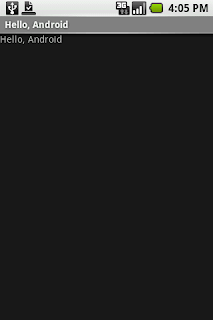 This was captured with the very developer friendly screenshot capture utility which is provided as part of the DDMS perspective for any attached device.
The app will now have appeared in the DDMS perspective allowing heap and thread viewing etc, and you can then simply fire up the debug perspective and set breakpoints etc - all very smooth - works well.
UPDATE: Of course you can skip the adb bit and transfer and run the app in a single step from and Android style eclipse run/debug launch configuration!
PS. Credits - much of this process was picked up from here and here.
PPS. The latest carnival is up over at Mobscure - and my previous post on the Scottish Software Awards gets a mention.
Our shiny new G1 arrived yesterday - now down to me to make something work on it! Lots of other folks have reviewed the device from a user perspective, generally coming to the conclusion that it is a great OS somewhat let down by the HTC hardware. Won't disagree with that view, but my focus here is going to be on app development for the beast.
Guess I am showing my age and deteriorating eyesight but I hate devices whose manuals only come on CD - always prefer paper given the choice. Once the manual painstakingly copied onto my PC desktop turned out to be the usual sort of standard - i.e. doesn't tell you much past the basics.
First challenge is simply to get the pathway worked out such that an app I create in eclipse over onto the G1 and fire it up.
Setting up the development environment under winxp is very smooth:
- Download the current (v1.0 r2) Android SDK and unpack in some sensible folder.
- Add https://dl-ssl.google.com/android/eclipse/ to your list of eclipse plugin download sites and install everything you find there.
- Restart eclipse and in the new Android properties section stick in the path to the SDK directory.
- Extend your system path variable to include the SDK's tools directory.
To connect the shiny new phone to the PC so the debugger can see it you need to:
- On the phone go into settings-->applications-->development and switch on USB debugging.
- Connect the phone and when it screams about the missing driver point it towards the usb_driver subdir in the SDK folder.
- (Re)start eclipse and the phone should appear in the DDMS perspective.
> adb install HelloAndroid.apk
And there we are:
 This was captured with the very developer friendly screenshot capture utility which is provided as part of the DDMS perspective for any attached device.
The app will now have appeared in the DDMS perspective allowing heap and thread viewing etc, and you can then simply fire up the debug perspective and set breakpoints etc - all very smooth - works well.
UPDATE: Of course you can skip the adb bit and transfer and run the app in a single step from and Android style eclipse run/debug launch configuration!
PS. Credits - much of this process was picked up from here and here.
PPS. The latest carnival is up over at Mobscure - and my previous post on the Scottish Software Awards gets a mention.
Monday, December 01, 2008
A fun night at the awards!
Unusually for this blog, which is usually more about things in the wider industry, am unashamedly going to concentrate on our own success today. I hope you will allow me this indulgence!
For those who don't know exactly what Mobile Acuity is all about (and yes we really must update the website sometime soon) the core thing we provide is a mechanism to allow users to interact with a mobile service by taking pictures with their phone, generally as part of brand marketing campaigns. Specifics vary between campaigns but we can then do things like:
While Mobile Acuity's technologies and services have underpinned projects which have won a number of awards so far this year, and we have even been allowed to talk about some of them publicly like Vodafone "Shoot and Score" which was succinctly summarised by techgutter, Friday night was the first awards we have contested in our own right since I have joined the company. The project we based our entry on was also the first I worked on after joining the company.
The awards in question were the Scottish Software Awards, an annual bash celebrating the best of the industry in Scotland, held in the Radisson SAS Hotel in Glasgow. Usefull and interesting group of people to chat to over drinks beforehand, and then through to the awards.
Was great to see so many companies shortlisted in the wireless / mobile category - good sign for the health of the sector in Scotland! Other than ourselves the shortlist consisted of:
Update: A good summary with a bit of a twist in the tail over at Fasterfuture with Richard Marshall as guest contributor.
PS. The latest carnival is up over at All About iPhone - though by Steve Litchfield rather than Matt Radford!
For those who don't know exactly what Mobile Acuity is all about (and yes we really must update the website sometime soon) the core thing we provide is a mechanism to allow users to interact with a mobile service by taking pictures with their phone, generally as part of brand marketing campaigns. Specifics vary between campaigns but we can then do things like:
- recognise what the picture is of - e.g. specific promo materials etc. User friendly linkage between print and mobile media.
- recognise which particular part of the target the user has "pointed" their phone at - image zoning.
- recognise/extract the colours in the image - colour id.
- extract parts of the image and rework into media (e.g. video) to return to the user - virtual bluescreen.
While Mobile Acuity's technologies and services have underpinned projects which have won a number of awards so far this year, and we have even been allowed to talk about some of them publicly like Vodafone "Shoot and Score" which was succinctly summarised by techgutter, Friday night was the first awards we have contested in our own right since I have joined the company. The project we based our entry on was also the first I worked on after joining the company.
The awards in question were the Scottish Software Awards, an annual bash celebrating the best of the industry in Scotland, held in the Radisson SAS Hotel in Glasgow. Usefull and interesting group of people to chat to over drinks beforehand, and then through to the awards.
Was great to see so many companies shortlisted in the wireless / mobile category - good sign for the health of the sector in Scotland! Other than ourselves the shortlist consisted of:
- Mobiqa - mobile barcodes, in particular for airline boarding passes at present.
- NXVision - placeshifting and sideloading TV media onto mobile.
- Rapid Mobile - mobile apps and the Ad360 interstitial mobile ads platform.
- Real Time Engineering - network services.
- Valley Technology - PODFather mobile proof of delivery system.
Update: A good summary with a bit of a twist in the tail over at Fasterfuture with Richard Marshall as guest contributor.
PS. The latest carnival is up over at All About iPhone - though by Steve Litchfield rather than Matt Radford!
Friday, November 21, 2008
A Future of Mobile?
Among the many interesting presentations at Monday's Future of Mobile conference in London was a wonderfully provocative short presentation by Helen Keegan of BeepMarketing telling us that there may be no future for mobile!
For the details see her blog on the subject, but in short she presented six key issues that need urgently to be resolved ...
The fundamental need for communication will ensure there is a future for mobile - but how well the industry deals with the issues above will decide how painful or otherwise it is!
PS. Latest carnival is up on the Mippin blog - and I got a mention!
For the details see her blog on the subject, but in short she presented six key issues that need urgently to be resolved ...
- The tech rather than the users are the focus.
- Silly, unpredictable, and often downright scary tarifs and charges. A regular moan of mine!
- Apps and services created by geeks for geeks - what about normal folks?
- A culture gap between mobile and web folks.
- Western cultural focus of the industry.
- The key purpose of the phone - to communicate - is being lost.
The fundamental need for communication will ensure there is a future for mobile - but how well the industry deals with the issues above will decide how painful or otherwise it is!
PS. Latest carnival is up on the Mippin blog - and I got a mention!
Sunday, November 16, 2008
Beem mobile payment - a fad or the future of cash?
I should come clean straight away and say I do struggle to understand why I might want to make day-to-day payments using my mobile phone - but then I am nearly 40 and so perhaps I am missing the point ;-)!
I was interested to see the new payment service from Beem which was announced recently. This so far allows users to pay for pizzas and taxi rides from some providers in the London area by sending txts from their mobile phone.
Their business model is Oyster-like in that the user's Beem account is charged up via debit card payments whenever it falls below a minimum and so Beem will generally be left holding a credit balance on which they can earn interest. They take fees from merchants as well but these are allegedly significantly lower than for more conventional payment methods.
Unfortunately the whole service is based on users interacting by sending structured SMS messages. Very paypalmobile-esque.This leads to two significant issues:
Looking a little more broadly it will be interesting to see the progress of the ongoing convergence between travel passes and contactless payment mechanisms e.g. the barclaycard+paypass+oyster combination card. Perhaps in due course it might make sense for these to converge with the mobile device? I remain to be convinced.
I was interested to see the new payment service from Beem which was announced recently. This so far allows users to pay for pizzas and taxi rides from some providers in the London area by sending txts from their mobile phone.
Their business model is Oyster-like in that the user's Beem account is charged up via debit card payments whenever it falls below a minimum and so Beem will generally be left holding a credit balance on which they can earn interest. They take fees from merchants as well but these are allegedly significantly lower than for more conventional payment methods.
Unfortunately the whole service is based on users interacting by sending structured SMS messages. Very paypalmobile-esque.This leads to two significant issues:
- The user error rate will be very high leading to large support costs and loss of user confidence.
- There will be significant moble messaging costs associated with operating the service.
Looking a little more broadly it will be interesting to see the progress of the ongoing convergence between travel passes and contactless payment mechanisms e.g. the barclaycard+paypass+oyster combination card. Perhaps in due course it might make sense for these to converge with the mobile device? I remain to be convinced.
Monday, November 10, 2008
OS aspects of Android start to appear?
One of the big disappointments of what has been written about the T-Mobile G1 so far is that the email client appears to be pretty poor unless you happen to use Gmail - probably a showstopper for me since non-gmail email is one of my core on-phone activities.
I was interested and reassured today to come across the k9mail project on Google Code. This project is based on a fork of the actual email client source code from Android and is working to improve it in a number of ways.
Early days - but great to see that OS self help cycle starting to kick off on a phone platform!
PS. Latest carnival is up over at ubiquitousthoughts.
I was interested and reassured today to come across the k9mail project on Google Code. This project is based on a fork of the actual email client source code from Android and is working to improve it in a number of ways.
Early days - but great to see that OS self help cycle starting to kick off on a phone platform!
PS. Latest carnival is up over at ubiquitousthoughts.
Wednesday, November 05, 2008
Tidal flow --> Data --> Fruit & Vegetables!
Intrigued to see the Guardian article describing a planned data centre in the north of Scotland backed by Morgan Stanley.
The Pentland firth area has huge potential for tidal power generation but the problem of how to get all that power (plus that generated by the extensive wind and wave resources of the area) from such a remote area down to where it is needed in the central belt of Scotland and beyond has yet to be solved convincingly.
This plan takes the opposite approach and moves one of the key power consumers in the modern economy close to the renewable energy supply. It is after all much easier to provide reliable data connections to a remote location than large capacity power transmission. As a side effect it also brings jobs to the area.
All very worthy so far but there is also an intriguing twist in the tail is mentioned on the main contractor Atlantis Resources' site. The heat generated by the data centre will not just be vented to the environment as normal but will be used to heat the adjacent Mey Selections greenhouses on the Castle of Mey estate.
What an all round excellent idea!
PS. The latest carnival is up over at mopocket.
The Pentland firth area has huge potential for tidal power generation but the problem of how to get all that power (plus that generated by the extensive wind and wave resources of the area) from such a remote area down to where it is needed in the central belt of Scotland and beyond has yet to be solved convincingly.
This plan takes the opposite approach and moves one of the key power consumers in the modern economy close to the renewable energy supply. It is after all much easier to provide reliable data connections to a remote location than large capacity power transmission. As a side effect it also brings jobs to the area.
All very worthy so far but there is also an intriguing twist in the tail is mentioned on the main contractor Atlantis Resources' site. The heat generated by the data centre will not just be vented to the environment as normal but will be used to heat the adjacent Mey Selections greenhouses on the Castle of Mey estate.
What an all round excellent idea!
PS. The latest carnival is up over at mopocket.
Subscribe to:
Posts (Atom)


